Inclusive reading practice evaluation tool for schools
The Inclusive Reading Practice Evaluation is a self-evaluation tool for schools, designed to help leaders and teachers review reading provision and strengthen inclusive reading practice.
It supports professional reflection across decoding, language development and comprehension, helping schools identify strengths, prioritise next steps and improve reading provision for pupils, including those learning through English as an additional language.
Developed with Anna Leaman

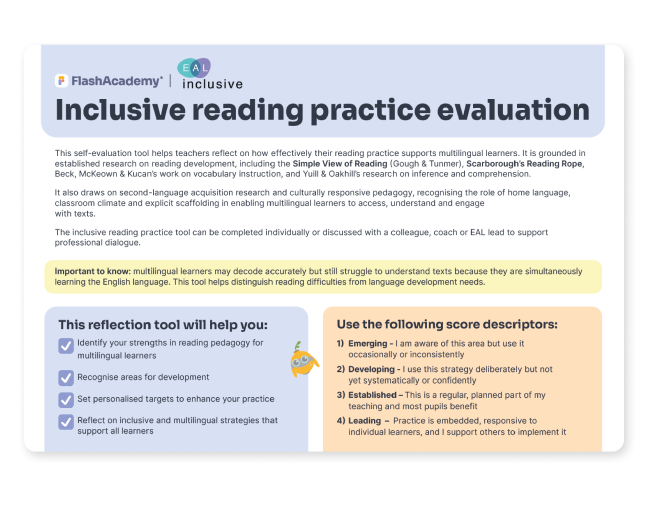
The inclusive reading practice evaluation, developed in collaboration with Anna Leaman, Director of EAL Inclusive, is an interactive self-evaluation tool designed to help schools review how effectively their reading provision supports EAL (English as an Additional Language) and multilingual learners.
Grounded in research on second language acquisition and reading development, the tool draws on established frameworks including Gough and Tunmer’s simple view of reading and Scarborough’s reading rope.
It helps schools consider how decoding, language development and comprehension interact for pupils learning to read in an additional language.
Review and strengthen inclusive reading practice
This interactive PDF helps schools evaluate reading provision across five key areas of inclusive practice. It is designed for literacy leads, school leaders, classroom teachers and inclusion leads who want a structured way to reflect on current provision and identify practical next steps.
Using the tool, schools can:
- review how effectively reading provision supports a wide range of learners
- identify strengths and areas for improvement
- support professional discussion and staff development
- align practice with evidence-informed approaches to reading
- strengthen reading provision across the school
What the Inclusive Reading Practice Evaluation includes
The tool is organised around five areas of reflection:
- knowing pupils’ reading strengths and target areas
- understanding how children learn to read
- responding to barriers to reading
- using appropriate reading materials
- adapting learning and texts to suit individual learners
It also prompts reflection on classroom strategies including vocabulary teaching, inference, structured talk, visual scaffolds, dual-language texts, translanguaging and home-language support, helping schools connect reading theory with day-to-day practice.
Who this reading self-evaluation tool is for
This resource is designed for schools that want to strengthen inclusive reading practice through a clear and practical review process. It is particularly useful for:
- literacy leads
- reading leads
- senior leaders
- classroom teachers
- inclusion leads
- staff leading professional development
How the tool supports better reading provision
Strong reading provision goes beyond decoding alone. Pupils may decode accurately but still need support with vocabulary, oral language, inference and comprehension in order to access and understand increasingly challenging texts. This tool helps schools reflect on those different elements of reading and evaluate whether current provision is meeting learners’ needs in a structured, consistent way.
Download the Inclusive Reading Practice Evaluation tool
Complete the form to access the Inclusive Reading Practice Evaluation and explore practical ways to strengthen reading provision in your school.
Frequently asked questions
Inclusive reading practice is an approach to reading provision that ensures all pupils, including EAL and multilingual learners, can access high-quality reading instruction, appropriate texts, language support and meaningful opportunities for comprehension.
Schools can support multilingual learners in reading by combining decoding instruction with explicit vocabulary teaching, oral language development, structured talk, comprehension strategies, visual scaffolds, home-language support and carefully chosen texts.
An EAL reading self-evaluation tool helps schools reflect on how well their reading provision supports learners with English as an additional language. It can be used to identify strengths, guide professional discussion and set priorities for improvement.
Home language supports concept development, comprehension and meaning-making. When schools recognise and build on pupils’ full linguistic repertoire, they can strengthen literacy development and improve access to reading.
The tool includes five sections covering assessment, reading development, barriers to reading, text choice and adaptation for individual learners, along with scoring, reflection prompts and next-step planning.