Why home language matters in EAL: The benefits of bilingualism and translanguaging
Why home language matters
For EAL learners, there are added layers of complexity to their learning journey. With both their peers and teachers, students are navigating new social norms and conventions, building relationships and trying to integrate into school life – all while learning a new language.
Encouraging the use of home languages in the classroom enables learners to express their emotional needs more fully and accurately, as well as unlocking their multilingualism as a valuable learning resource.
Is bilingualism beneficial?
Research has long pointed to bilingualism as a strength. Cummins (1979) developed a hypothesis of interdependence, arguing that proficiency in a learner’s home language supports second language development because both draw on a “common underlying proficiency.” He went on to argue that both cognitive and literacy skills developed in the home language transfer to the second language.
Bialystock (2008) found that the experience of controlling attention to two languages boosts the development of executive function in bilingual children, sustaining these processes through adulthood and protecting against decline with ageing.
Marian and Shook (2012) agreed that bilingualism could stave off age-related cognitive decline as well as showing benefits in early years with bilingual children as young as seven months showing smoother adjustment to environmental changes. They also identified that bilingualism has been associated with improved metalinguistic awareness, as well as with better memory, visual-spatial skills and even creativity.
These benefits are supported by Yurtsever, Anderson and Grundy (2023) whose analysis of 147 studies provided evidence that bilingual children outperform monolingual children on executive function tests.
What is translanguaging?
Translanguaging is a pedagogical approach that allows students to use the full range of their language resources, including their home language and the language of classroom instruction.
The term originates in Welsh bilingual education, where educator Cen Williams first coined the Welsh word trawsieithu in a 1994 evaluation of bilingual teaching methods. He described a pedagogical practice where students intentionally alternated languages for different tasks to deepen their comprehension. García and Li Wei (2014) later introduced translanguaging as a pedagogical approach and there has been a large and growing body of research exploring its potential benefits for language learning.
Kuswidyasari and Kasau (2025) undertook a narrative review of global practices in translanguaging, highlighting both strengths and limitations to the model. The review indicated that translanguaging improves academic performance by supporting conceptual understanding and learner engagement as well as validating identity. However, they identified that monolingual ideologies, policies and limited teacher preparation still present challenges.
Cummins (2002) highlights the need for explicit, structured instruction in each language to facilitate language proficiency. Translanguaging presents a promising framework, especially for inclusion and identity and there are multiple studies indicating significant learner benefits. The body of research is complicated by potential inconsistencies in translanguaging pedagogy and the need for further empirical research.
Instructional translation: Using home languages in the classroom
By using the full range of their language skills, your EAL learners can feel empowered to participate more fully in their learning journey.
Cummins’ concept of a common underlying proficiency for EAL learners provides a basis for instructional translation.
So, how can you introduce this in the classroom?
Enabling learners to discuss, note-make, plan and brainstorm in their home language can help them access higher order thinking before then encouraging and supporting them to translate their key ideas and vocabulary into English. If learners in the classroom share a home language, pairing them for these tasks can support their thinking.
Bilingual dictionaries and books can support access to concepts explored in curriculum subjects, supporting familiarity between the home language and English wording and phrasing.
Translation of core ideas, success criteria and key vocabulary can avoid cognitive overload.
Drawing attention to shared roots and differences in sentence structure can help to develop linguistic awareness.
Enabling EAL learners to access their home language in the classroom, when combined with strong instruction means that multilingualism can be harnessed by learners to access a range of cognitive resources.
Home language and parental involvement
Sénéchal and LeFevre(2003) found that parental involvement in teaching children about reading and writing was related to the development of early literacy skills which then in turn directly predicted word reading at the end of grade 1 and indirectly predicted reading in grade 3.
The impact of parental involvement in literacy is well established and the need to engage parents of EAL learners in their learning journey is an important consideration for schools. Dong and Chow‘s (2022) meta-analysis indicated that parental involvement can be the key to maximising the usefulness of home literacy environment resources in supporting children’s EAL development.
Bautista Thomas (2015) suggests that translanguaging offers a way to embrace the child’s home language and culture by bringing it into the classroom space, and for learners, inclusion of their parents or carers in their learning gives an important message about their sense of belonging in the school environment.
How can schools engage the parents of EAL learners in a thoughtful and inclusive way?
Providing translation and interpretation services for consultations and communication.
Creating a welcoming environment using multilingual displays and signs.
Including parents and carers in cultural celebrations and seeking their input and ideas.
Encouraging home language use to boost home language proficiency for better learning outcomes.
Collaborative homework activities that involve multilingual approaches.
Digital tools that support multilingual approaches to learning
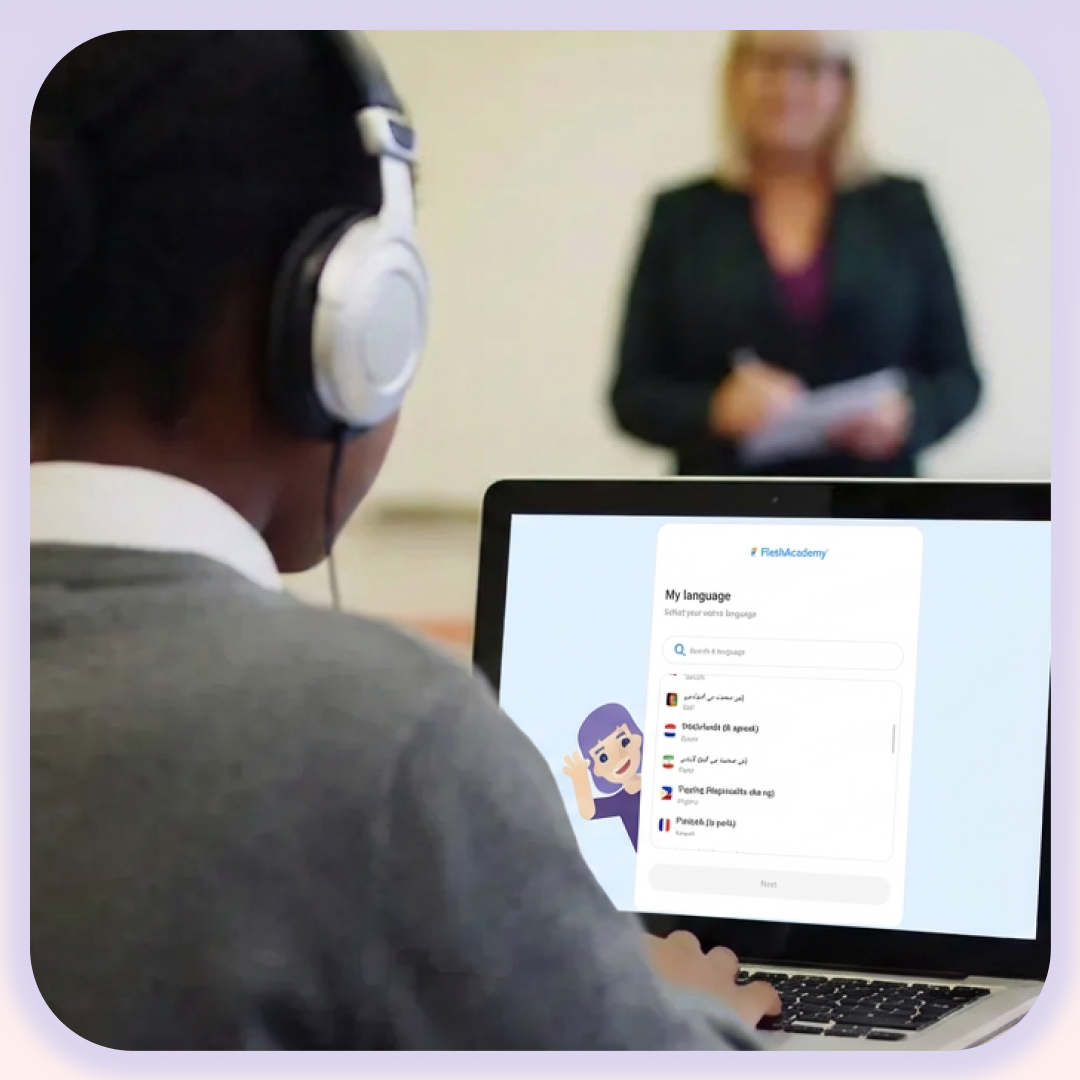
Digital tools, like FlashAcademy® can offer an important bridge between home and school for EAL learners.
FlashAcademy®’s home language interface supports learners across 48 home languages to use translanguaging approaches, showing direct translation between the home language and corresponding English word in lessons. FlashAcademy® supports 45% of learners to improve across a 12-month period, compared with the national average of 18%. Learners can employ their full range of language learning skills for quicker acquisition.
The app lessons are also pedagogically designed by language specialists to support language acquisition using evidence-based learning techniques. You can read more about our pedagogical approach in our blog: What is FlashAcademy and how does it work?
The learning app’s availability offline and across a range of devices enables learners to share their learning journey with parents and carers, supporting multilingualism at home.
Multilingualism as an asset
Research shows that when bilingual and multilingual learners are presented with the opportunity to employ their range of language skills, their language acquisition and overall achievement is boosted significantly.
Schools need to harness the skills of EAL learners, keeping expectations high for their progress. In combining a culture of identity and belonging with structured approaches to language development and introducing pedagogically informed approaches to translanguaging and bilingual instruction, EAL learners can achieve greater language equity in their learning experience and be supported to reach their potential.