Equity in schools: Why the UK’s EAL challenge is the next big equity issue
Why EAL is no longer a niche issue
For too long, policymakers in the UK have treated English as an Additional Language (EAL) as a niche requirement. The current picture tells us a different story. EAL is part of a structural shift with learners present in almost every classroom in the country.
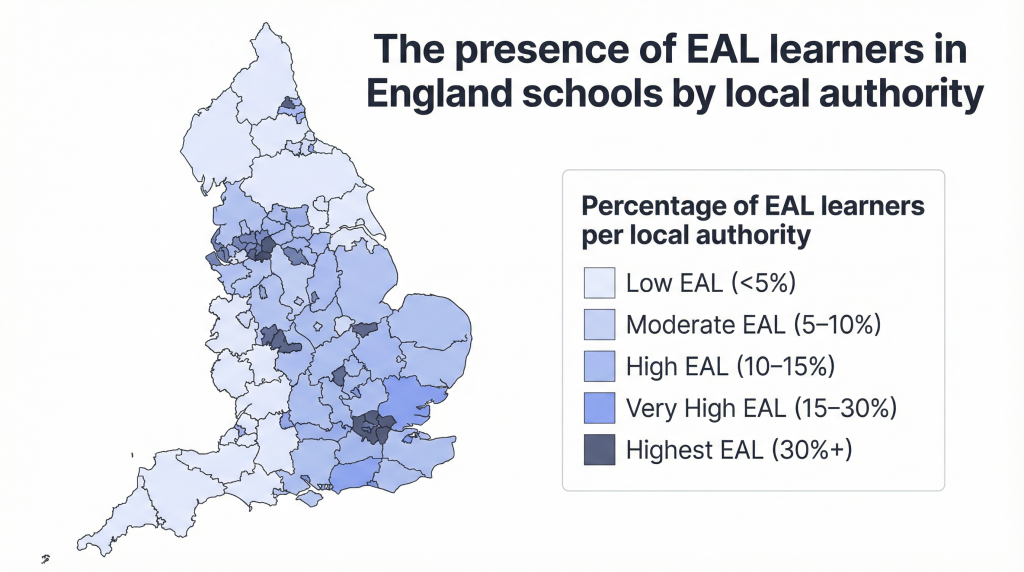
21% of all pupils in England speak a home language other than English, rising to 44% in London. Across the UK, 2.2 million EAL learners attended state-funded schools in 2024.
The diffusion of these students is a key change. Department for Education data shows that over 84% of schools in England support at least one EAL pupil, in both rural and urban areas. In some of the more diverse regions, teachers are managing between 40 and 60 different languages simultaneously.
This shift is unfolding against a wider cultural backdrop. Research from Kings College London and Ipsos found that half the public today feel the UK culture is changing too fast, up from 35% five years ago. 48% say they want their country the way it used to be. Amidst this rising challenge, EAL in schools has become pivotal. My blog, EAL learners and the power of belonging: shaping inclusion in schools , examines how belonging shapes the experiences of EAL learners and why it has become a growing priority for achieving equity in schools.
Why language proficiency shapes life chances
Strand and Hessel found that proficiency in English explains up to 22% of the variation in EAL pupils’ academic achievement, compared to the 3–4% explained by factors such as gender or socio-economic status. In addition to language barriers, EAL learners experience interrupted education, socio-economic disadvantage and in many instances, uncertain migration status. These issues can compound the challenges faced by EAL learners in achieving a sense of safety that Maslow recognised as essential to achieving human potential.
And inequity doesn’t stop at school. According to The Migration Observatory, lower English language proficiency makes employment less likely – and those in employment are more likely to be in low-skilled work.
According to NHS England, people with limited English are more likely to experience poor health, adverse events and life-threatening conditions and struggle to access care when they need it. With around one million people in the UK unable to currently speak English well or at all, the implications are profound. Language equity in schools through the provision of good EAL provision shapes EAL learners’ ability to navigate society, access services and live healthier, more secure lives long after they leave school.
A DLUHC-commissioned evaluation warns that people whose first language isn’t English can “drop off early” in housing application processes without translated information and support. Evidence from Hunter et al also identifies systemic barriers in the legal justice system, calling for better data, rights and access to English language support to enable rehabilitation and integration.
EAL learners need equity for good employment, health and wellbeing outcomes.
When equity depends on a postcode
Provision for EAL varies dramatically between schools – not because of need, but because of geography, leadership priorities and local budgets. Whereas some schools have specialist EAL leads, structured assessment pathways and CPD, others rely on subject teachers managing EAL as an “add-on” to their daily responsibilities. The lack of standardisation for EAL coordinator roles or qualifications in both the UK and internationally indicates the lack of prioritisation given to this growing body of multilingual students by policymakers.
Equity in schools demands more than access to the same curriculum and policymakers must recognise EAL as a core equity issue, no less essential than safeguarding or SEND. The evidence tells us that the futures of these children depend on it.
For multi-academy trusts, consistent EAL frameworks can pave the way to a sense of belonging and equity for learners. In her blog, EAL learners’ wellbeing: A moral imperative for school leaders, Helen Williams, Trust EAL lead for Fairfax MAT discusses the steps they took to make EAL wellbeing a whole-school and trust-wide priority across every setting.
Why teachers are struggling to close the EAL gap
Teachers operate in busy classrooms with competing demands, managing dual responsibilities – delivering curriculum content while simultaneously building pupils’ English proficiency. With more than 5 million teacher-led language assessments annually according to sector estimates, that’s a significant administrative burden and time best spent with personalising support for EAL learners.
At FlashAcademy®, we’ve focused on embedding strong EAL pedagogy into the design of our platform while reducing the administrative burden placed on teachers. AI-assisted marking, saves an average of around 150 hours per teacher. Scaled across England’s school system, that time saving represents an estimated £11–13 million efficiency gain each year. It frees up time and resource for personalised support, improved provision and better outcomes for learners.
We hear from many teachers who don’t feel they’ve had sufficient training in EAL pedagogy. The pace of curriculum delivery often leaves little room for reflection and CPD. With 40 languages spoken across the classroom, teachers need support and cannot rely on intuition or ad-hoc strategy. EAL needs to be a strategic priority for all school leaders. FlashAcademy® created Grow in recognition of this need, a self-paced CPD programme for educators in EAL.
The one thread that unifies the educators we work with is their desire to push for the best for their students. Educators are often doing a remarkable job in extraordinary circumstances in the absence of a clear EAL framework, which is where we act as a bridge for schools in closing that equity gap for their learners.
EAL is not the responsibility of one coordinator. It touches every subject, every classroom and every interaction. When schools integrate language development throughout the curriculum rather than isolating it, learners benefit. With well supported teachers, robust strategy and sustained commitment, integrated approaches can succeed.
The new Ofsted framework looks at how inclusion can be embedded as a whole-school priority, with a checklist for EAL for state-funded schools. This places responsibility on everyone in the school to help support and shape outcomes for EAL learners.
A whole-school approach allows for common teaching strategies, shared expectations and alignment. We encourage this through offering unlimited teacher logins with FlashAcademy®. Every teacher can track learners’ progress and contribute to their language learning experience.
Inclusive classrooms strengthen learners’ sense of belonging and engagement with their learning. When leaders set the vision, schools can shift from reactive support to planning proactively to address issues of language equity.
The purposeful use of data enables schools to track student progress and understand their needs as well as demonstrating impact. These are key issues highlighted in the EAL state-funded schools inspection toolkit. Our teacher dashboard and exportable data helps schools to embed a whole-school approach that keeps them inspection-ready.
A vision for language equity in UK schools
My vision for FlashAcademy® is that no child is held back by a language barrier. For true equity in schools, addressing language proficiency is pivotal.
Our international schools harness multilingualism as an asset. The benefits of bilingualism are well established, driving creativity, self-awareness and flexibility, according to Marian and Shook. These are significant skills for any learner to take with them into the world of work. Home languages are a key part of a learner’s identity and can help to maximise their learning potential.
I would love to see a system where schools have access to standardised, research-informed guidance on EAL strategy and teaching. Assessment should be meaningful and fair.
What needs to change – and how EAL Futures will help drive it
Schools need clear, consistent standards for EAL provision; something currently missing at national and international level. The rising EAL and multilingual population in the UK and globally needs funding matched to requirements.
EAL coordinators need support and training pathways. Assessment and data collection should shape meaningful progress for learners.
We’ll focus on how schools, trusts and groups can track, measure and report meaningful data, shaping better learning experiences for multilingual learners. EAL Futures explore key issues affecting multilingual learners in the UK and internationally. It will also explore how purpose built pedagogical technology – PedTech – can complement robust EAL strategy for improved outcomes.
Through EAL Futures, we want to bring together teachers, school leaders and the wider sector to build a shared understanding of what effective EAL strategy looks like and why it matters for equity in schools. By sharing evidence, insight and practice, we aim to shape better futures for EAL learners.